

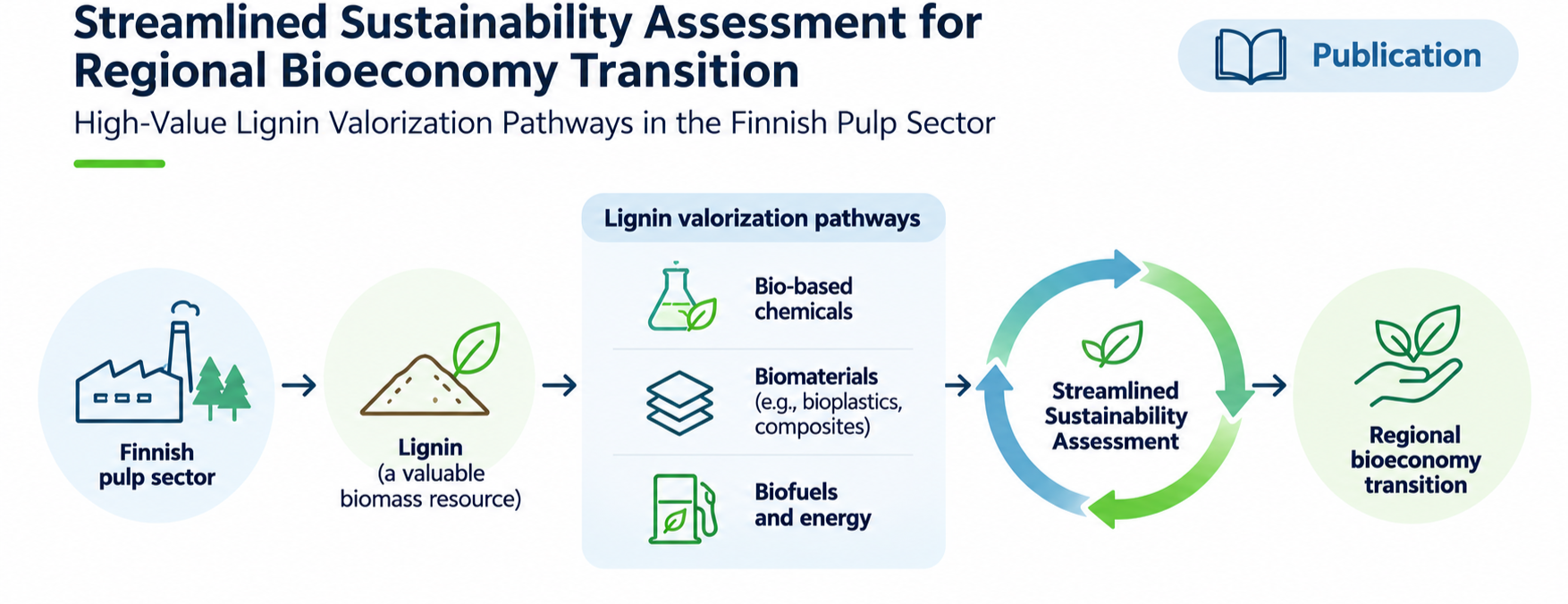
Our new scientific article, titled “Streamlined sustainability assessment for regional bioeconomy transition: High-value lignin valorization pathways in the Finnish pulp sector,” has just been published in the international scientific journal Resources, Conservation and Recycling.
The publication explores how lignin, a by-product of the pulp and paper industry, can be transformed into high-value products, supporting the transition towards a more sustainable and circular bioeconomy.
In Finland’s pulp industry, kraft lignin is traditionally burned to generate energy. However, its potential use as a raw material for innovative products offers new opportunities to reduce environmental impacts and dependence on fossil-based resources.
The study introduces a streamlined sustainability assessment framework designed to support decision-making at the early stages of developing lignin-based technologies. By combining environmental assessments with socio-economic considerations and incorporating stakeholder and expert perspectives, the framework helps address data limitations that often affect emerging technologies.
The researchers examined three potential applications of lignin:
- Adhesives for wood boards
- Anodes for car batteries
- Plasticizers for concrete
The results demonstrate the significant environmental potential of lignin valorisation. Across 16 environmental impact categories, lignin-based products performed better than fossil-based alternatives in 13–14 categories, depending on the assessment approach.
Notably, the study found that:
- Lignin-based adhesives could reduce climate change impacts by 83% compared to fossil-based alternatives.
- Lignin-based battery anodes could achieve a 57% reduction in climate change impacts.
- Adhesives achieved the highest overall sustainability score (796/1000) under attributional life cycle assessment.
- Under consequential life cycle assessment, adhesives and anodes achieved equally strong sustainability scores (751/1000).
These findings highlight the potential of lignin-based products to contribute to industrial decarbonisation while creating new opportunities for resource efficiency and circular value chains.
Read the full publication here!